Loading…
Biography
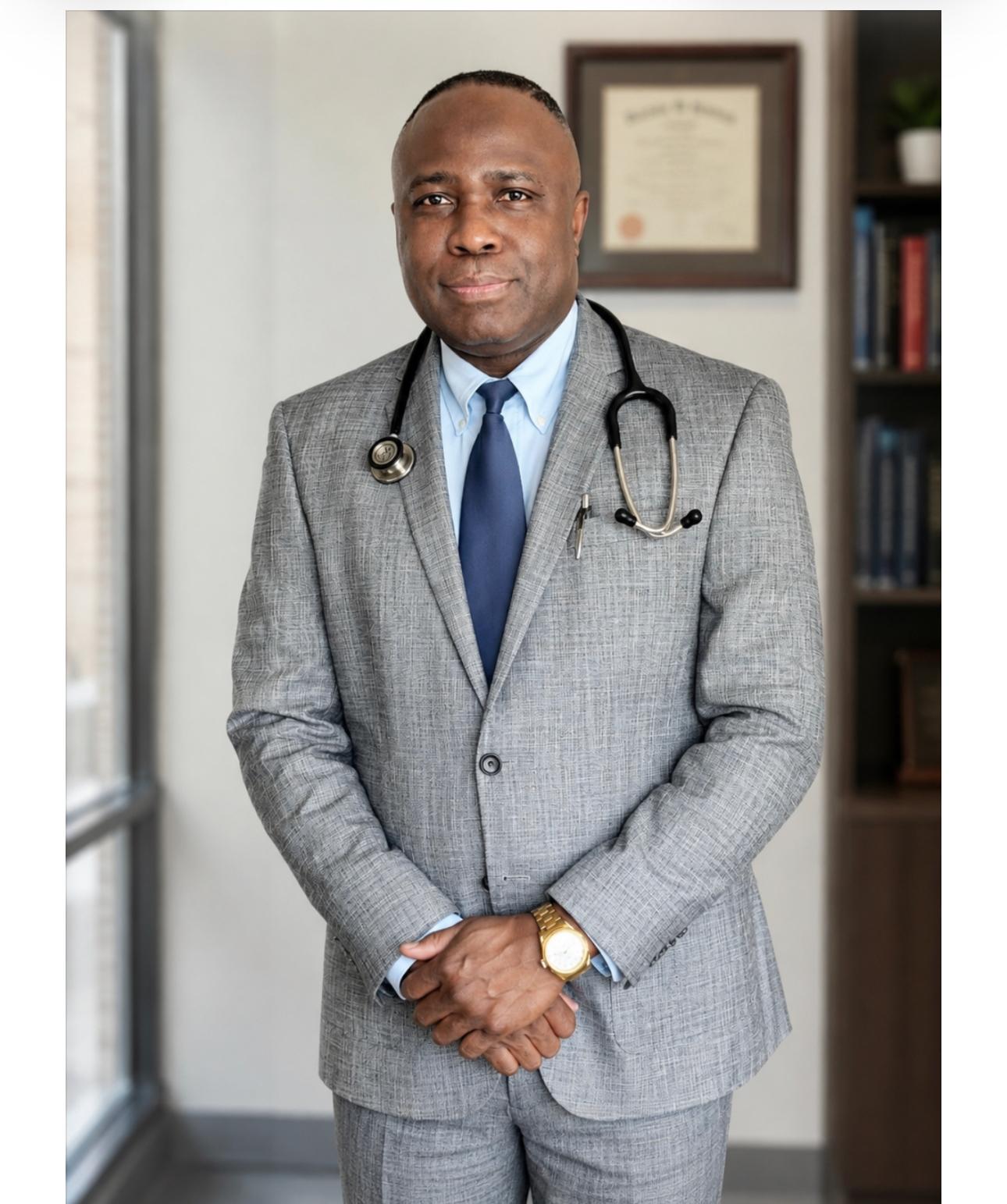
About Dr. Robert Sakulanda
Physician. Scientist. Author. Father. Immigrant. MD, MBA, FAAFP, DABFM. His story is proof that the path to purpose is rarely a straight line — it is built from the questions we refuse to stop asking.
The early journey
Robert's story began in the communities of Zambia, where he first understood what medicine means to a family — not as an abstraction, but as the difference between fear and reassurance, between loss and more time. That early understanding became a compass that has guided him across two continents and every chapter since.
Migration taught him the rest: how to begin again, how to rebuild an identity in a new country, and how much of medicine — and of life — translates without a common language. Attention. Empathy. The willingness to sit with people in their hardest moments.
Medicine
He has practiced medicine for more than two decades — first in family medicine, following people across years and generations, and now as a hospitalist in Georgia, where he cares for admitted patients at Wayne Memorial Hospital in Jesup and has served communities from Warner Robins to Roswell. The two roles are two perspectives on the same human being. Family medicine follows people through time; hospital medicine meets them at their most fragile hours. Both require the same discipline: to listen first, and to treat the person, not only the disease.
The pandemic asked more of medicine than anything in a generation — and it asked the same of the people standing inside it.
The frontline: COVID-19
When COVID-19 arrived, Robert stood where the pandemic was most real: at the bedsides of critically ill patients. He has described those months as a defining classroom — nights when protocols changed faster than anyone could learn them, when families said goodbye through phones, and when medicine's limits became impossible to ignore.
The experience changed him in two ways at once. It deepened his conviction in the human side of care — presence, honesty, tenderness. And it planted a question he could not put down: where are the better tools? Why is the distance between the laboratory and the patient still so long?
Biotechnology & scientific interests
Rather than leave that question at the bedside, he followed it into formal study. He earned a Master of Science in Applied Biotechnology from the University of Wisconsin–Madison, deepening his understanding of vaccines, gene editing, and emerging medical technologies — the fields that will decide what the next health crisis looks like, and how many lives the next generation of medicine can save.
His scientific interests now sit deliberately at the junction of discovery and delivery: how breakthroughs move from bench to bedside, how patients come to understand — and trust — new technologies, and what clinicians owe the public when science moves faster than common language.
Writing
Writing is where the two halves of his working life — the ward and the laboratory — finally speak to each other. On the page, the urgency of patient care meets the patience of science: essays and stories that translate complex ideas into human terms, and that keep the dignity of sick people at the center of every technical conversation.
His first book, drawn from his frontline experience and his journey into biotechnology, is currently in the works. Details will be announced on this site.
Entrepreneurship & global perspective
His commitment extends beyond clinic and laboratory into entrepreneurship — the conviction that good ideas deserve to become real services, real access, and real change. It is a conviction he has practiced: since 2017 he has owned and rebuilt Mufulira United Football Club in Zambia's Copperbelt — a civic institution he sees as social infrastructure for young people — and he mentors young African entrepreneurs in shaping and executing business proposals.
His ties to Zambia run deeper than investment. He returns regularly on medical missions, carrying the same bedside discipline across the ocean — a worldview shaped by communities in the United States and Zambia alike: health is produced by systems, and systems can be built better.
As a father, he carries one more reason to care about the long game. The future he works toward — in his practice, his studies, and his writing — is the one his children and yours will inherit.
Mission
To practice medicine with humanity, pursue science with curiosity, and tell stories that connect people to a healthier future.
Selected Journey
Chapters of the path
01
Medicine
Where it begins
Robert's path began in Zambia and led to more than two decades of clinical practice — first in family medicine, learning to listen carefully across years and generations, then at the bedside as a hospitalist caring for patients through their most vulnerable moments.
02
The Frontline
COVID-19
When the pandemic arrived, he cared for critically ill patients on the front lines of COVID-19 in Georgia hospitals — an experience that reshaped his understanding of medicine, fragility, and human resilience.
03
Biotechnology
Master's studies
The pandemic raised questions that medicine alone could not answer. He returned to graduate study and earned a Master of Science in Applied Biotechnology from the University of Wisconsin–Madison — studying vaccines, gene editing, and emerging medical technologies.
04
Scientific Exploration
Bench to bedside
His work now lives at the junction of discovery and care — following how breakthroughs in the laboratory become treatments, and what they mean for real people and communities.
05
Writing
Finding the words
Medicine gave him stories; science gave him perspective. Writing became the way he carries both — translating the human experience of illness and hope into language everyone can share.
06
Purpose
The road ahead
I wrote Behind the Mask because I couldn't carry what I saw in silence. During the pandemic, I was a physician at the bedside, trained in family medicine, hospital medicine, and critical care, holding the hands of frightened patients and answering questions from families when I didn't have easy answers. I went home exhausted, haunted by faces and conversations I couldn't set down. This book is how I finally started to set them down.
Since then, I've gone back to school for my master's in biotechnology, and I've spent time in the world of vaccine production, where I saw how much careful, quiet work goes into protecting people. That's when I realized how wide the gap was between what I lived through in hospitals and what many people understood about the science. I wrote this book to close that gap, to share what it felt like on the frontline and to explain, in plain language, how vaccines are built and tested. If my story helps even one reader trade fear for understanding, then writing it was worth it.
Expertise
Areas of focus
Family Medicine & Hospital Medicine
More than two decades of clinical practice spanning primary care and hospital medicine — caring for patients in Georgia communities as a board-certified family physician (DABFM) and hospitalist, and a Fellow of the American Academy of Family Physicians (FAAFP).
Biotechnology & Emerging Science
Graduate training in applied biotechnology at the University of Wisconsin–Madison, with focused study of vaccines, gene editing, and the emerging medical technologies shaping tomorrow's care.
Business & Healthcare Leadership
An MBA and years of health-system experience inform his work as an entrepreneur — from building clinical teams to community investment, including ownership of Mufulira United Football Club in Zambia.
Global Health & Mentorship
Regular medical missions in Zambia and hands-on mentoring of young African entrepreneurs — a worldview shaped by communities in the United States, Zambia, and beyond, committed to broadening access to a healthier future.
The journey continues on the page.
Read Behind the Mask: one doctor, many battles, and a purpose greater than fear.
Buy the book